Sacramentology
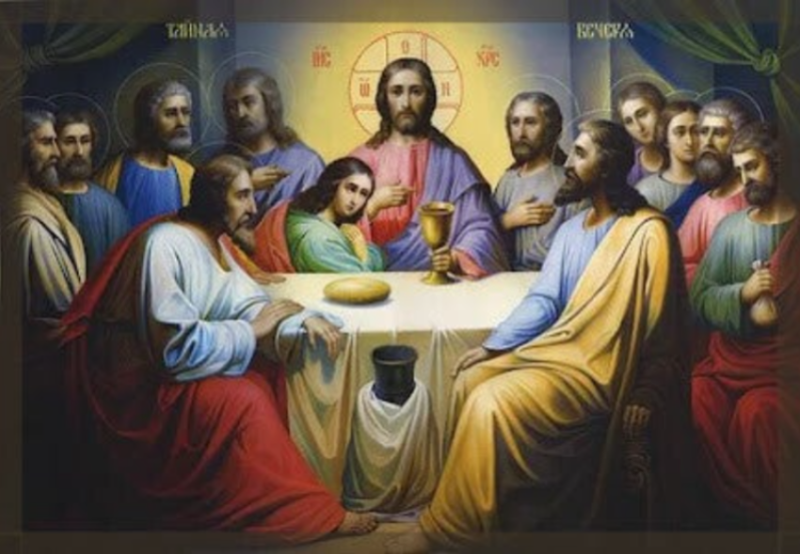
While they were eating, Jesus took a loaf of bread, and after blessing it he broke it, gave it
to the disciples, and said, “Take, eat; this is my body.” Then he took a cup, and after
giving thanks he gave it to them, saying, “Drink from it, all of you; for this is my blood of
the covenant, which is poured out for many for the forgiveness of sins. I tell you, I will
never again drink of this fruit of the vine until that day when I drink it new with you in my
Father’s kingdom.
Matthew 26, 26-29
The chalice of benediction, which we bless, is it not the communion of
the blood of Christ? And the bread, which we break, is it not the
partaking of the body of the Lord?
1 Corinthians 10, 16
My Explications of the Patristic Texts
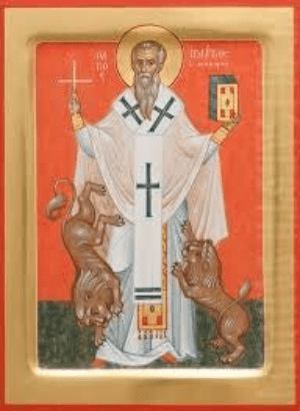
St. Ignatius of Antioch (c A.D. 110)
Epistle to Smyrnaeans, 7,1
“They [Gnostics] abstain from participating in the Eucharist and from prayer because they do not
acknowledge the Eucharist as the flesh of Jesus Christ, who suffered for our sins and was raised
by the Father. Those who speak against this gift of God bring judgment upon themselves. It would
be better for them to revere it so they might have eternal life. Therefore, it is appropriate to keep
away from such people and not talk about them, but instead, pay attention to the teachings of
the prophets and, most importantly, the Gospel, which reveals the Passion and fully proves the
Resurrection. Avoid all divisions, as they lead to evil.”
Ignatius, Bishop of Antioch, discusses the beliefs of the Gnostics, a religious group known for their distinct interpretation of Christian doctrine. They rejected the orthodox doctrine of Christ’s incarnation, maintaining that he was just a phantasm who only appeared to be genuinely human. Thus, Ignatius states that Gnostics abstain from participating in the Eucharist—an important sacrament in Christianity that represents the body and blood of Jesus Christ—and from prayer. The reason for this abstention is their rejection of the Eucharist as the true flesh and blood of Jesus, who suffered for humanity’s sins and was resurrected by God.
The author warns against those who criticize or oppose the Eucharist, emphasizing that such actions carry serious consequences—bringing judgment upon themselves. It suggests that reverence for the Eucharist is essential for attaining eternal life, implying that recognizing and honoring this sacrament is a vital aspect of faith.
Furthermore, Ignatius advises believers to distance themselves from individuals or groups that do not share this belief, specifically those who diverge from the traditional teachings of prophets and the Gospel. He highlights the importance of focusing on the core teachings of the Gospel, which emphasize Jesus’ suffering (the Passion) and resurrection, as these are central to the Christian faith.
Finally, the text warns against divisions within the faith community, asserting that such divisions lead to negative outcomes, or “evil.” In summary, the message encourages unity in belief, adherence to fundamental Christian doctrines, and an appreciation for the significance of the Eucharist in the context of salvation.
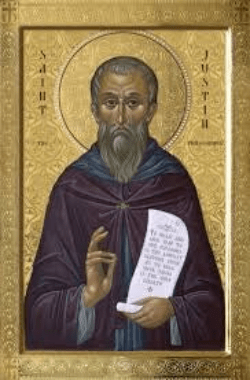
St. Justin Martyr (A.D. 155)
First Apology, 66
“For not as common bread and common drink do we receive these; but in like manner as
Jesus Christ, our Saviour, having been made flesh and blood for our salvation, so likewise
have we been taught that the food which is blessed by the prayer of His word and from
which our blood and flesh by transmutation are nourished, is the flesh and blood of that
Jesus who was made flesh.”
This text discusses the significance of the Eucharist in early Christian theology, emphasizing the belief in the transformation of ordinary elements—bread and wine—into the sacred body and blood of Jesus Christ.
Justin Martyr begins by asserting that the bread and wine used in the Eucharist are not ordinary sustenance. Unlike common food and drink, which serve merely to satisfy physical hunger, these elements hold a deeper spiritual significance.
The author draws a parallel between the Eucharistic elements and Jesus Christ himself. He emphasizes that Jesus, as the Savior, became incarnate—taking on human flesh and blood for humanity’s salvation. This incarnation is essential to understanding the divine nature of the Eucharist.
The term “transmutation” indicates a transformation, suggesting that the bread and wine, when blessed, undergo a change of substance that allows believers to receive physical and spiritual sustenance. This idea aligns with the doctrine of transubstantiation, which asserts that the substance of bread and wine changes into the actual body and blood of Christ while retaining their physical or accidental appearances.
Ultimately, the text conveys that partaking in this blessed food profoundly nourishes believers, who receive the flesh and blood of Christ. This nourishes their spiritual lives and strengthens their relationship with God.
In summary, this passage underscores the deep spiritual significance of the Eucharist, highlighting its foundation in the incarnation of Christ and the belief in its transformative power to provide spiritual sustenance to believers.
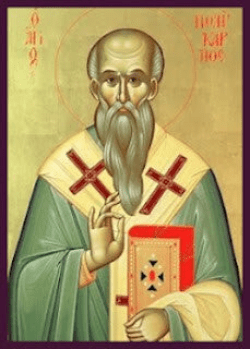
St. Irenaeus of Lyons (c A.D. 190)
Against Heresies, V:2,2
“He acknowledged the cup (which is a part of the creation) as his own blood, from which he
bedews our blood; and the bread (also a part of creation) he affirmed to be his own body, from
which he gives increase to our bodies.”
The text conveys a deep theological idea about the relationship between the physical elements of bread and wine and their spiritual significance in the context of Christian beliefs, particularly in the Eucharist or Holy Communion.
The reference to “the cup” and “the bread” as parts of creation emphasizes the material nature of these elements. They are not mere symbols, but rather integral aspects of the physical world that God has made. This establishes a link between the divine and the material.
By stating that the cup is “his own blood” and the bread is “his own body,” the text highlights the concept of transubstantiation found in the Catholic tradition. It suggests that through divine intervention, these elements take on a new, sacred reality during the Eucharist. The bread and wine substantially become the body and blood of Christ through the power of the Holy Spirit.
The phrases “bedews our blood” and “gives increase to our bodies” suggest a transformative effect. The blood symbolizes life and sacrifice, implying that through the consumption of these elements, believers receive spiritual nourishment and vitality. This aligns with the idea that partaking in the Eucharist strengthens one’s faith and connection to the divine.
Overall, the text reflects the belief that participating in the sacrament allows individuals to partake in the divine life of Christ, both nurturing their spiritual health and deepening their relationship with God. It emphasizes the sacred connection between the physical and spiritual realms, illustrating how ordinary elements can serve as conduits for divine grace and sustenance.
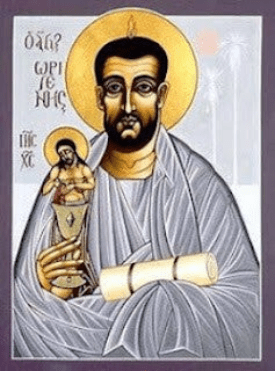
St. Clement of Alexandria (A.D. 202)
The Instructor, 2
“The blood of the grape, symbolizing the Word, wanted to be mixed with water, just as His blood
is mixed with salvation. The blood of the Lord has two aspects: His flesh’s blood, which redeems
us from corruption, and the spiritual blood, which anoints us. Drinking the blood of Jesus means
sharing in the Lord’s immortality, as the Spirit is the driving force of the Word, just as blood is for
the flesh. Therefore, as wine is mixed with water, so is the Spirit with humans. The mixture of
wine and water nourishes faith, while the Spirit leads to immortality. The combination of both
the water and the Word – is called the Eucharist, a renowned and glorious grace. Those who
partake of it by faith are sanctified in body and soul.”
St. Clement discusses deep theological concepts related to the sacrament of the Eucharist, highlighting the significance of the blood of Christ in both physical and spiritual dimensions.
The phrase “blood of the grape” emphasizes the symbolic relationship between wine and Christ’s blood, which is often represented in Christian rituals. This blood is linked to the Word, suggesting that Jesus’ teaching and essence are intertwined with His sacrificial act.
The author introduces two aspects of Jesus’ blood: “Flesh’s Blood” refers to the physical blood of Christ that redeems humanity from sin and corruption, underscoring a doctrine of salvation through His sacrifice. “Spiritual Blood” signifies the anointing and empowerment provided by the Holy Spirit, indicating that divine grace produced by Christ’s sacrifice is essential for spiritual life.
“Drinking the Blood of Jesus” expresses the idea of participating in Christ’s eternal life. By “drinking” His blood, believers are said to share in His immortality, emphasizing the transformative power of faith.
“Wine and Water” parallels the mixing of wine and water, symbolizing the union of the divine Spirit with human beings. This mixture serves a dual purpose: It strengthens and nourishes the faith of believers, and the Holy Spirit is portrayed as essential for attaining immortality.
The term “Eucharist” refers explicitly to the sacramental act in which believers participate in the body and blood of Christ. It is described as a “renowned and glorious grace,” signifying its importance and sacredness in Christian practice.
Finally, the Bishop of Alexandria states that participants of the Eucharist who engage by faith are sanctified in both body and soul, indicating that this sacred act brings about a holistic transformation and communion with God.
Overall, the explication reveals a rich theological assertion about the nature of Christ’s redemptive act, the role of the Holy Spirit, and the transformative power of the Eucharist in the life of believers. The text encourages a profound engagement with these spiritual truths through faith.

St. Cyprian of Carthage (A.D. 253)
To Caeilius, Epistle 62(63):13
“For because Christ bore us all, in that He also bore our sins, we see that in the water is
understood the people, but in the wine is showed the blood of Christ. Thus, in consecrating the
cup of the Lord, water alone cannot be offered, even as wine alone cannot be offered. For if
anyone offers wine only, the blood of Christ is dissociated from us; but if the water is alone, the
people are dissociated from Christ. When both are mingled and joined with one another by a close
union, there is a completed spiritual and heavenly sacrament. Thus, the cup of the Lord is neither
water nor wine alone unless each is mingled with the other. On the other hand, the body of the
Lord cannot be flour alone or water alone unless both should be united, joined together, and
compacted in the mass of one bread. In this very sacrament, our people are shown to be made
one, so that in like manner as many grains, collected, and ground, and mixed together into one
mass, make one bread; in Christ, who is the heavenly bread, we may know that there is one body,
with which our number is joined and united.”
Cyprian of Carthage addresses the theological significance of the elements used in the sacrament of Holy Communion, specifically focusing on the combination of water and wine. He articulates the belief that Christ’s sacrifice encompasses both the act of bearing humanity’s sins and the unification of believers through the sacrament.
The Bishop of Carthage begins by explaining that water represents the people while wine represents the blood of Christ. This duality is essential for understanding the sacrament’s full meaning. The significance lies in the connection created between Christ and the congregation.
Cyprian affirms that neither water nor wine should be offered alone in the sacrament. Offering only wine would imply a separation of Christ’s blood from the believers, while offering only water would disconnect the community from Christ himself. The mingling of the two signifies the necessary relationship between Christ and His followers. Blood and water flowed from Jesus’ side after it was pierced by a soldier’s lance as he hung upon the cross, and shortly after, he commended his spirit to the Father and passed away. Water represents spiritual regeneration through the sacrament of Baptism. The blood of Christ is the source of the grace of justification and forgiveness received in Baptism (See John 19:34; 1 John 5:6).
The proper offering, therefore, must unite both elements to create a complete spiritual sacrament. This union signifies a deeper relationship between Christ and the church community, highlighting that both he and the believers are intertwined in a sacred bond.
Similar to the mingling of water and wine, the body of Christ is not just represented by flour or water alone but requires a union of both to create one bread. This serves as a metaphor for the church, comprised of many individuals who come together as one body through Christ.
Cyprian’s closing thoughts emphasize the unity brought about by this sacramental act. Just as individual grains of wheat are ground and mixed to form one loaf, so are the believers merged into one body through Christ. This reflects the communal aspect of faith, illustrating that individuals participate collectively in the mystery of the blessed sacrament.
Overall, the text beautifully articulates the importance of unity in the practice of Communion, emphasizing that a meaningful sacrament requires the joining of both elements to reflect the relationship between Christ and His followers. It highlights the theology of community in the Christian faith, underscoring that individual believers are part of a larger whole in their relationship with Christ.
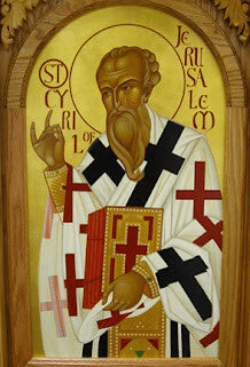
St. Cyril of Jerusalem (c A.D. 350)
Catechetical Lectures, XXII:8
“Having learned these things, and been fully assured that the seeming bread is not
bread, though sensible to taste, but the Body of Christ; and that the seeming
wine is not wine, though the taste will have it so, but the Blood of Christ; and
that of this David sung of old, saying, And bread strengthens man’s heart, to
make his face to shine with oil, ‘strengthen thou thine heart,’ by partaking
thereof as spiritual, and ‘make the face of thy soul to shine.’”
St. Cyril delves into the theological understanding of the Eucharist, specifically the belief in transubstantiation, where the substances of bread and wine used in Communion are believed to substantially transform into the actual Body and Blood of Christ, despite still appearing as bread and wine to the senses.
The phrase “the seeming bread is not bread” suggests a deeper, spiritual, or metaphysical truth that transcends physical perception. The idea is that what is experienced through taste and sight is not the essence of the sacrament; rather, it holds a sacred significance that believers must grasp beyond their senses.
The mention of David’s psalm links the significance of bread to spiritual nourishment. Bread symbolizes sustenance, both physical and spiritual, in many religious contexts. The quoted part, “And bread strengthens man’s heart,” emphasizes that partaking in the Eucharist provides bodily nourishment and strengthens the soul and spirit.
The author exhorts believers to engage with the sacrament thoughtfully. “Strengthen thou thine heart” implies a call to seek spiritual fortification through this sacred act, indicating that partaking in the Eucharist is intended to uplift and renew one’s inner being.
The suggestion that participation in the Eucharist can “make the face of thy soul shine” highlights the sacrament’s transformative power. It calls believers to reflect inner grace outwardly, indicating that spiritual health leads to visible manifestations of joy and divine light.
Overall, the text invites a meditation on the mystical dimensions of faith and the profound significance of its rituals, urging believers to understand and appreciate the deeper meanings and effects of their religious practices.
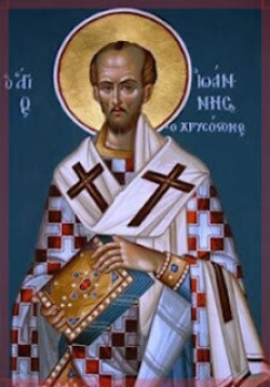
St. John Chrysostom (A.D. 370)
Gospel of Matthew, Homily 82
“Let us then in everything believe God, and gainsay Him in nothing, though
what is said seem to be contrary to our thoughts and senses, but let His word be
of higher authority than both reasonings and sight. Thus let us do in the
mysteries also, not looking at the things set before us, but keeping in mind His
sayings. For His word cannot deceive, but our senses are easily beguiled. That
hath never failed, but this in most things goeth wrong. Since then the word
saith, ‘This is my body,’ let us both be persuaded and believe, and look at it with
the eyes of the mind. For Christ hath given nothing sensible, but though in
things sensible yet all to be perceived by the mind…How many now say, I
would wish to see His form, the mark, His clothes, His shoes. Lo! Thou seest
Him, Thou touchest Him, thou eatest Him. And thou indeed desirest to see His
clothes, but He giveth Himself to thee not to see only, but also to touch and eat
and receive within thee.”
John Chrysostom’s Homily on Matthew emphasizes the importance of faith in God’s word over human reasoning and sensory perception. It argues that divine truth remains unwavering while our senses can mislead us. The author encourages believers to have confidence in God’s declarations, particularly in relation to the mysteries of faith, such as the Eucharist, as expressed in the phrase “This is my body.”
The core message is that believers should approach spiritual truths with a mindset that transcends physical evidence. The passage critiques the desire to perceive God through tangible means, such as wanting to see Christ’s physical attributes (His form, garments, etc.). Instead, it suggests that Christ offers a deeper connection through communion—believers can see, touch, and consume Him trans-substantially in a spiritual sense.
This perspective calls for a conviction that values the inner understanding and acceptance of faith. It illustrates that while outward appearances may tug at our curiosity, the essence of faith lies in recognizing and embracing the spiritual reality offered by God, which is ultimately more profound than what can be observed or measured by our senses.
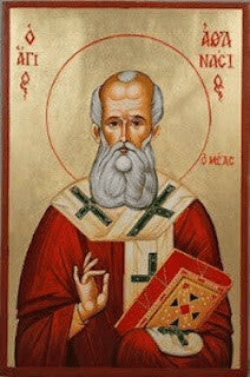
St. Athanasius of Alexandria (A.D. 373)
Sermon to the Newly Baptized, PG 26, 1325
“You will see the Levites bringing the loaves and a cup of wine, and placing them o
the table. So long as the prayers and invocations have not yet been made, it is mer
bread and a mere cup. But when the great and wonderous prayers have been recited
then the bread becomes the body and the cup the blood of our Lord Jesu
Christ…When the great prayers and holy supplications are sent up, the Word
descends on the bread and the cup, becoming His body.”
St. Athanasius describes a liturgical practice associated with the Eucharist, emphasizing the transformation of ordinary elements—bread and wine—into the sacred body and blood of Christ during the sacred Eucharistic celebration.
The mention of the Levites, who were members of the Hebrew tribe entrusted with priestly religious duties, indicates a connection to traditional practices and the importance of the community in the liturgy. They bring forth the bread and wine, which are essential components of the Eucharist in the New Covenant church.
Athanasius highlights that prior to the recitation of prayers and invocations, the bread and wine were merely food items. This reflects a broader theological concept where physical substances can become more than their material nature through spiritual acts. The “great and wondrous prayers” signify a moment of divine interaction. He suggests that it is through these prayers that a transformation occurs. This aspect underscores the belief in the significance of prayer in connecting the spiritual and material realms.
The transformation where the bread becomes the body of Christ, and the wine becomes His blood is a core belief in Christianity, particularly within Catholicism. This doctrine—known as transubstantiation—illustrates the belief that, during the Eucharist, the elements truly become the physical presence of Christ in substance while not in appearance. The phrase “the Word descends” signifies an active presence of the divine during the ritual, suggesting that it is not just a symbolic action but one that invokes God’s presence and power.
In essence, the text emphasizes the profound spiritual significance attributed to the Eucharist, framing it as a moment where the ordinary becomes extraordinary through divine grace and prayer.
St. Ambrose of Milan (A.D. 390-391)
On the Mysteries, 9:50
“Perhaps you will say, ‘I see something else, how is it that you assert that I
receive the Body of Christ?’ And this is the point that remains for us to prove.
And what evidence shall we make use of? Let us prove that this is not what
nature made, but what the blessing consecrated, and the power of blessing is
greater than that of nature, because by blessing nature itself is changed…The
Lord Jesus Himself proclaims: ‘This is My Body.’ Before the blessing of the
heavenly words another nature is spoken of, after the consecration, the Body is
signified. He Himself speaks of His Blood. Before the consecration, it has another
name, after it is called Blood. And you say, Amen, that is, It is true. Let the
heart within confess what the mouth utters, let the soul feel what the voice
speaks.”
The text reflects a theological argument concerning the Eucharist, specifically the transformation of bread and wine into the Body and Blood of Christ during the Mass. The speaker anticipates a question or skepticism regarding the assertion that the faithful receive the Body of Christ. To address this, they argue that the transformation of the Eucharistic elements is not a result of their natural properties but rather occurs through the divine act of blessing or consecration.
St. Ambrose contrasts the natural state of bread and wine with their consecrated form. He suggests that the power of divine blessing surpasses natural characteristics, indicating that these elements are transformed through faith and divine intervention into something sacred.
The Bishop cites Jesus’ words, “This is My Body” and “This is My Blood,” emphasizing that these statements denote a change in the nature and essence of the elements. Before the consecration, they are merely bread and wine; after, they really become the Body and Blood of Christ.
The response “Amen” signifies belief and acceptance of this transformation. It calls for a deeper acknowledgment from both heart and soul, urging the faithful to align their inner conviction with the outward expression of belief through the spoken word.
Ambrose encourages a holistic approach to faith, where one’s heart and inner feelings resonate with what is professed verbally. This suggests that understanding and belief in the sacrament should penetrate beyond mere words into a deep spiritual realization.
In essence, the text affirms the belief in Transubstantiation, where bread and wine become the actual Body and Blood of Christ during the Eucharist, and calls the faithful to a deeper understanding and acknowledgment of this sacred mystery.
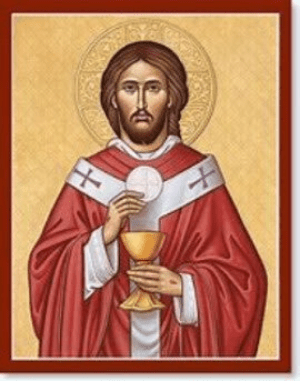
He that eats my flesh, and drinks my blood,
dwells in me, and I in him.
John 6, 56

PAX VOBISCUM
 Catholicity
Leave a comment